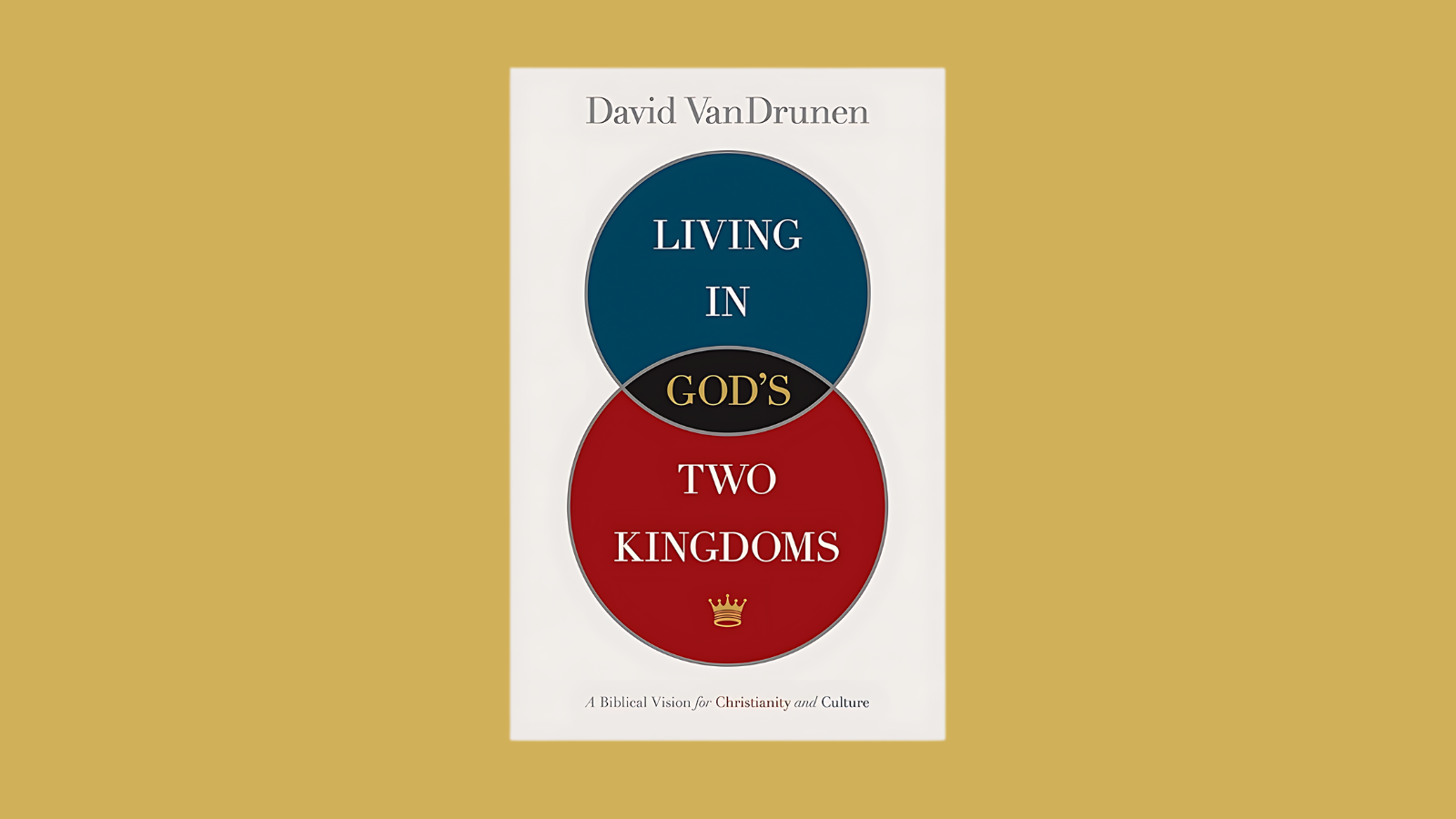
So far in this series, we have examined how VanDrunen’s radical two kingdoms (R2K) theology creates an unbiblically divided vision of life (e.g., dualistic). First, we examined his views on creation, the cultural mandate, and redemption. By dividing reality into the common and redemptive kingdoms, VanDrunen drives a wedge throughout Christian life. Next, we considered how this sharp division led him to argue that the redemptive kingdom (e.g., the church) transcends justice. Thus, VanDrunen downplays the role of justice in the kingdom and devalues it as a divine characteristic.
VanDrunen undermines the foundation of Christian ethics by degrading the importance of justice. This article examines the final two chapters of Living In God’s Two Kingdoms and the shocking and inescapable trajectory of VanDrunen’s theology.[1] We see this trajectory in VanDrunen’s treatment of worship, education, and abortion.
Is Worship Only for the Church?
VanDrunen’s system separates the redemptive kingdom, that is, the church, from the common kingdom (everything else). From this division, he argues for different roles and ethics in each of the two kingdoms. The common kingdom has an ethic of justice, whereas the redemptive kingdom seeks mercy. Concerning roles, he separates worship as belonging only to the redemptive kingdom. Of course, worship is uniquely tied to God’s redemptive acts. However, as VanDrunen excludes creation from the redemptive kingdom, he again runs afoul of Scripture. He writes:
Believers share a variety of cultural activities with unbelievers in the common kingdom, but worship has never been one of them. The universal Noahic covenant of Genesis 9 commanded nothing about worship. (135)
As an activity of the redemptive kingdom, worship is an activity of the church. (135)
As VanDrunen exiles creation from the redemptive kingdom, he also cuts off creation from worship. Only the redemptive kingdom worships God, and creation is not part of it. Worship belongs only to the church. The problem is that Scripture does not limit worship to the church, or the so-called “redemptive kingdom.”
Consider these verses:
The heavens declare the glory of God, and the sky above proclaims his handiwork. (Psa. 19:1)
All your works shall give thanks to you, O Lord. (Psa. 145:10)
Let everything that has breath praise the Lord! (Psa. 150:6)
Let the sea roar, and all that fills it; the world and those who dwell in it! Let the rivers clap their hands; let the hills sing for joy together before the Lord, for he comes to judge the earth. (Psa. 98:7–9a)
The mountains and the hills . . . shall break forth into singing, and all the trees . . . shall clap their hands. (Isa. 55:12)
Some may object that these verses contain figurative language. Of course, such passages must not be understood literally, yet they do communicate that creation worships God in some form. If we sever creation from the redemptive kingdom (as VanDrunen does), then we miss the glory of Scripture’s universal call for worship. Creation is worshipful precisely because it is not regulated to the “common kingdom” and will be redeemed (Rom. 8:22–25).
Moreover, Revelation 5:13–14 tells of how every creature worships God and how that worship rises to God’s throne room:
And I heard every creature in heaven and on earth and under the earth and in the sea, and all that is in them, saying, “To him who sits on the throne and to the Lamb be blessing and honor and glory and might forever and ever!” And the four living creatures said, “Amen!” and the elders fell down and worshiped.
Whereas VanDrunen sees redemption as a division from creation, the Bible pictures it as a unification of all things under Christ (Col. 1:20; Eph. 1:10). As it can, creation worships God precisely because Christ’s work redeems the entire cosmos.
No Such Thing as Christian Education?
In these chapters, VanDrunen displays a nervousness around calling things outside of the church “Christian.” This includes education. He writes, “At the same time, we should be careful about how we use the term “Christian” to describe our education, work, politics, or other cultural endeavors” (162). Such things belong to the common kingdom. Thus, there is no binding “Christian view” of things like mathematics (163).
For VanDrunen, there is no fundamental difference between Christian and non-Christian standards in the common kingdom. He notes that, except for the “same moral requirements” for unbelievers, and that “the standards of excellence for such work are the same for believers and unbelievers” (168). For VanDrunen, there is no notable difference between the standards of pagans and Christians in the common kingdom.
He argues that because education belongs to the common kingdom, Christian schools should hesitate to have chapels, prayer services, or even mission projects (178). Again, VanDrunen’s sharp split between the areas of life takes center stage. Education and schools have no part in the redemptive kingdom; therefore, there is no such thing as a Christian school. He writes:
As ministers should hesitate to instruct about mathematics from the pulpit, so mathematics teachers should hesitate to instruct about missions and prayer in their school. Both ministers and teachers in the classroom should give careful though to what they teach and should strive to educate with excellence within the proper bounds that God has given them. (178–79)
Christianity is beyond the bounds of education because education is common, whereas Christianity is redemptive. Again, VanDrunen’s deficient view of creation clouds his judgment here. What is redemption if it is not the redeeming of creation from sin, the curse, and the reign of the evil one?
Consider the following three rebuttals. First, is there a Christian way of teaching mathematics and science? Yes. Consider how the political left labels “Western” math as “racist” and different from other cultural practices. As the Hoover Institution explains, “Students will be taught how ‘Western Math’ is used as a tool of power and oppression, and that it disenfranchises people and communities of color.” Mathematics is not as neutral as VanDrunen suggests.
As absurd as the woke proponents’ claims are, they are correct in stating that Western mathematics stands out. Western mathematics, due to the influence of Christianity, excelled where other cultures failed. The same is true of science, as Nancy Pearcey points out in her book The Soul of Science: Christian Faith and Natural Philosophy. Pearcey demonstrates how the scientific revolution burst onto the scene in the Christian West. This was not an accident in history. As Robert Clarke explains:
However we interpret the fact, scientific development has only occurred in a Christian culture. The ancients had brains as good as ours. In all civilizations—Babylonia, Egypt, Greece, India, Rome, Persia, China and so on—science developed to a certain point and then stopped. . . . For the non-Christian world believed that there was something ethically wrong about Science.[2]
Loren Eisley adds:
[Science] is an invented cultural institution, an institution not present in all societies. . . . The type of thinking known today as scientific, with its emphasis upon experiment and mathematical formulation, arose in one culture—Western Europe—and no other.[3]
Contrary to VanDrunen, there is such a thing as Christian mathematics and Christian science, and these are the truest expressions of those disciplines. Without the Christian foundation for science and mathematics, there would have been no scientific revolution.
Second, VanDrunen wrongly assumes that the morality needed to succeed in education, vocation, and other disciplines is common to all cultures and religions. They’re not. Vishali Mangalwadi notes how he and a fellow Indian spoke about the ease of success in the West. They noted that this success comes from the basic societal trust that exists in the West.[4] Centuries of Christian influence have made the West fundamentally different from nations where Christianity has not exerted such a profound force. While it is true that the same ethical standards apply to everyone, this is because Christianity is true. Where Christianity has not exerted such a culture-shaping force, these ethical standards are anything but common.
Third, these chapters reveal VanDrunen’s cultural blindness. Living in the West, after centuries of Christian influence, he was born on third base but thinks this is the neutral starting place for all cultures. It’s not. As Brian Mattson notes, we have a form of cultural amnesia: Westerners have forgotten their cultural inheritance. Much of what we take for granted springs forth from the culture-changing power of the gospel. In terms of world history, these events are anything but common. They are the exception and are found primarily in the Christianized West.
Abortion Is a Sin but Not a Crime?
In the political realm, VanDrunen’s view bears its worst fruit. One must wonder whether his entire system is constructed to shield him from the clear political teachings of Scripture. For example, he writes that political disagreements between Christians cannot be settled by the Bible, “Scripture itself cannot referee between them” (201). VanDrunen argues that Scripture belongs only to the redemptive kingdom. Conversely, politics belong only to the common kingdom. Scripture has no binding authority on the public sphere, and thus on the common kingdom. That’s right, God’s word does not have universal authority. VanDrunen has exchanged sola scriptura for a form of “Christian” secularism.
He explains:
In my judgment, the general rule is that the church must teach—and Christians may hold one another accountable for believing—all that Scripture says about such topics as moral issues but should be silent about such topic as concrete political or public policy issues. (199)
He drives a wedge between “moral issues” and politics. However, Scripture says that the state exists to enforce God’s morality on evildoers (Rom. 13:1–4). Politics are thoroughly and inescapably moral. However, VanDrunen searches for freedom from the authority of Scripture in public life.
To apply his view, VanDrunen uses abortion as a test case. He admits that abortion is a “sin” and that churches must treat it as such (200). In the redemptive kingdom, abortion is always a sin. However, he asserts that the church cannot say that abortion should be illegal. He writes:
Christians cannot simply assert that in an ideal world abortion should always and everywhere be illegal. . . . While Christians should never promote abortion as a social good, there are many different ways in which they might oppose abortion. (201)
As he explains the abortion issue, he also argues that Christians can vote for different candidates, and that we must not assert that our position is “the Christian view” (201). It appears that his system is designed to allow people to vote for whoever they want, especially those who are pro-abortion. In VanDrunen’s world, abortion is a sin, but voting to legalize abortion is not a sin! This is what happens when we ignore God’s word in any aspect of life.
For VanDrunen, abortion is a sin, but not necessarily a crime. What sin, though, is abortion? Surely, it is the sin of murder, the very sin God instituted the state to punish (Gen. 9:5–6; Rom. 13:1–4). The absurdity of VanDrunen’s reasoning is plain when it is applied to other issues:
Murder is always a sin but not necessarily a crime. The church cannot advocate for it to be illegal.
Theft is always a sin but not necessarily a crime. The church can’t advocate for it to be illegal.
Rape is always a sin but not necessarily a crime. The church cannot advocate for it to be illegal.
Child trafficking is always a sin but not necessarily a crime. The church cannot advocate for it to be illegal.
The list could continue indefinitely. VanDrunen’s reasoning is preposterous. His system drives an artificial wedge into Christian ethics that opens the door to growing evil in the common kingdom.
There is no space here to discuss the proper role of government, politics, and law. For those interested in further discussion, I wrote a book-length treatment of these issues.
Conclusion
The absurdity of VanDrunen’s view is displayed in the final chapter. He claims that he is not a dualist, yet the outworking of his theology betrays him as one. I am thankful for this final chapter, as it reveals how morally bankrupt his system truly is. Scripture and the Christian tradition offer a far better path forward.
While VanDrunen is a skilled writer, his views are riddled with exegetical errors and untenable outworkings. I have read many books about the Christian life and how Christianity should shape our living—some good, some mediocre, and some bad. By asserting that all of life is outside of the church is not part of Christ’s redemptive work, he robs life of its deep meaning. According to VanDrunen, everything we do outside the church will ultimately amount to nothing. It is common, and Christ’s work has little to do with it. God forfeits his creation to the evil one, and we are just waiting for it to go up in flames. In short, VanDrunen’s Living in God’s Two Kingdoms is the least inspiring vision of the Christian life I have ever read.
[1] David VanDrunen, Living in God’s Two Kingdoms: A Biblical Vision for Christianity and Culture (Wheaton, IL: Crossway, 2010).
[2] Robert Clarke, quoted in Henry Schaefer, Science and Christianity: Conflict or Coherence? (Watkinsville, GA: The Apollos Trust, 2003), 14.
[3] Loren Eiseley, quoted in Nancy Pearcey and Charles Thaxton, The Soul of Science: Christian Faith and Natural Philosophy (Wheaton, IL: Crossway, 1994), 17.
[4] Vishal Mangalwadi, The Book that Made Your World: How the Bible Created the Soul of Western Civilization (Nashville, TN: Thomas Nelson, 2011), 249–250.