
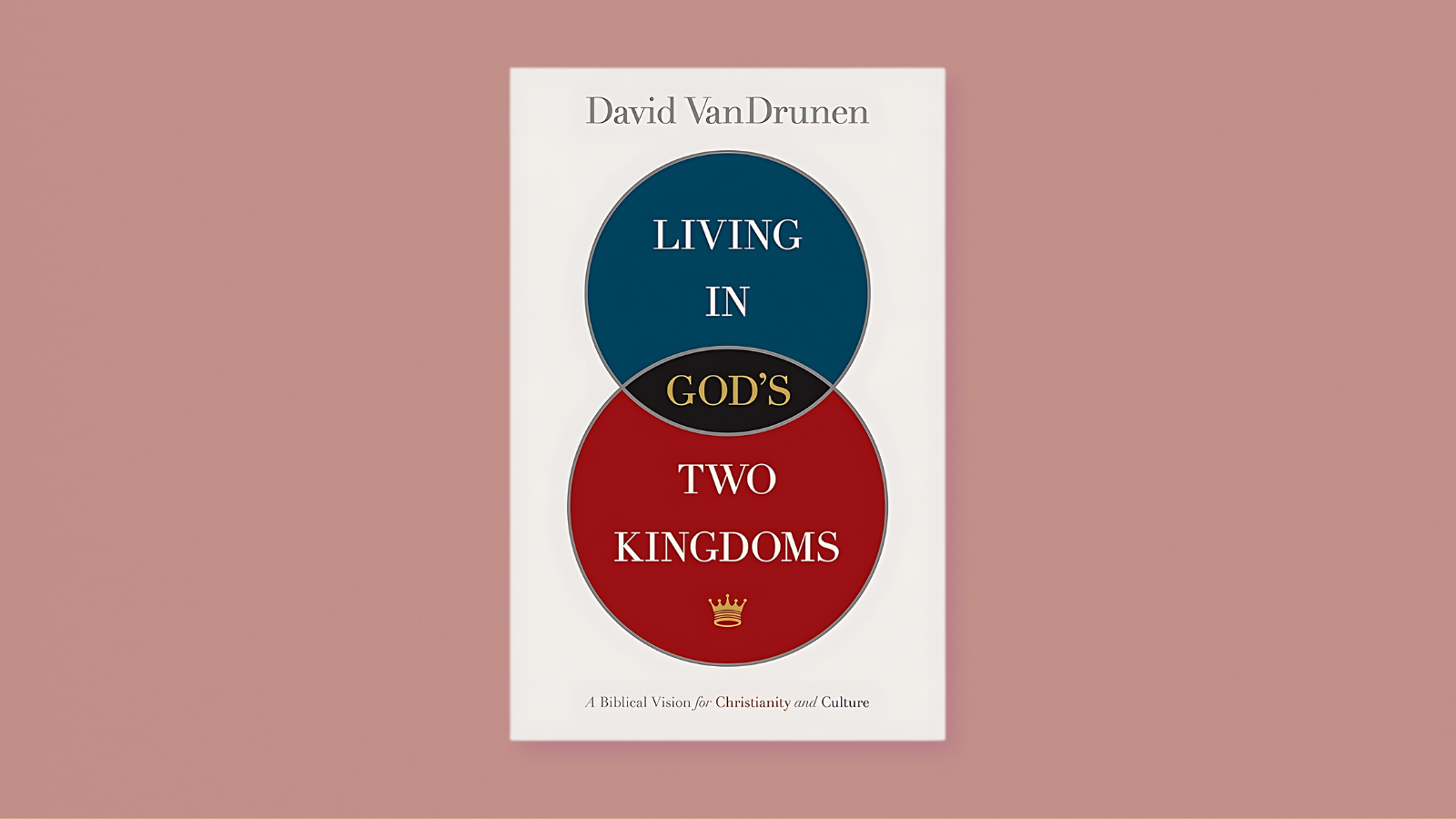
In my first article interacting with David VanDrunen’s Living in God’s Two Kingdoms, I examined his incomplete understanding of the doctrine of creation, the cultural mandate, and salvation.[1] VanDrunen’s work consistently relies on shoddy exegesis. Often, he lets his system (radical two kingdoms theology) form his exegesis. Continuing in his book, his treatment of passages like Galatians 1:4, John 18:36, and Colossians 3:1–6 belies someone who ignores the context of passages to prop up his system.
This is a constant problem for theologians. If we allow our theology to drive our exegesis (interpretation of passages), instead of allowing our exegesis to drive our theological conclusions, we will invariably end up in theological error. In short, our theology must be dictated by the biblical text.
This problem persists throughout his book, leading him to some dangerous and even head-scratching conclusions. This article focuses on how his dualistic understanding of God’s two kingdoms (e.g., the common and redemptive kingdoms) leads him to undermine the foundation of Christian ethics. This error has dire consequences later in the book.
VanDrunen’s Dualistic Ethic
Following his two-kingdom schema, VanDrunen divides ethics into that of the common kingdom or the redemptive kingdom. The redemptive kingdom is only the church, and the common kingdom encompasses everything else in this age. The common kingdom was ratified with the Noahic covenant, and all that is in that kingdom, except Christians, will not be redeemed. In this way, VanDrunen creates a sharp break, not only in the world but also in the lives of Christians. We live in both kingdoms simultaneously and must understand how to live in each of them. In short, the Christian life (and the world) is dualistic—it is either common or redemptive in nature.
This tension comes to a head as VanDrunen engages the ethics of the Sermon on the Mount (110–115). How should we understand Christ’s command to “turn the other cheek”? Here, VanDrunen pits Christ’s teaching against the Law of Moses. For him, the law is exiled to the common kingdom while Christ’s teaching is only binding in the redemptive kingdom. The law, and its focus on retributive justice, has nothing to do with the redemptive kingdom (110).
According to VanDrunen, the redemptive kingdom is not concerned with justice because it transcends this category. As he contrasts Christ’s ethics with the law, he writes:
Things are very different in the kingdom of heaven . . . Jesus explains that his kingdom is about forgiveness, reconciliation, and restoration. What if someone “has something against,” “slaps you on the right cheek,” or “persecutes you”? The response is not seeking justice but being “reconciled to your brother” . . . The kingdom of heaven is a realm where the demands of justice seem strangely transcended. (110)
He continues:
The kingdom of heaven, as the full flowering of the redemptive kingdom, is an amazing reality. . . In this kingdom Christians have nothing left to prove, no justice yet to achieve.” (111)
Thus, the redemptive kingdom is a place that transcends justice, where we forgo our claims to it. VanDrunen argues that the church is directed by Christ to put this “community ethic” into “practice in this world” (112). In this age, Christians are to transcend justice.
Thus, in a footnote, he explains that this means Christians should “refuse to pursue retributive justice” when people persecute them for being Christians (115). His dualistic vision of life creates two different ethical directions. In the common kingdom there is justice; in the redemptive kingdom there is mercy.
In summary, VanDrunen’s two kingdoms ethics separates the redemptive kingdom from justice because it reflects the kingdom of heaven, where justice is transcended. Therefore, two-kingdom ethics imply that retributive justice is, in some way, contrary to the character/ethic of the kingdom of heaven. Therefore, Christians are not to seek justice when they are persecuted.
Whenever our theological systems create unbiblical dualisms, they push us toward absurdity. VanDrunen’s ethic causes major problems for Christian ethics. It belittles justice as if it were something undesirable or deficient. What does this thinking communicate about the character of God? Does Scripture support such a sharp break between justice and the kingdom of God?
Scripture’s Testimony
If heaven, the place of God’s dwelling, transcends justice, then we should expect the testimony of Scripture to align with this teaching. But this is not the case. Four types of biblical texts flatly contradict VanDrunen’s dualistic ethic.
First, the very foundation of God’s throne is described as justice: “Righteousness and justice are the foundation of your throne” (Psa. 89:14). The Kingdom of God is marked by the rule of God, represented by His throne. God’s justice and righteousness are the foundation of the kingdom. Without justice, it’s not God’s kingdom. To suggest that the kingdom of heaven transcends justice distorts the character of the God who establishes that kingdom.
Second, several passages of the Prophets describe the kingdom as being marked by justice. Isaiah 9:7 says that the Messiah and his government shall increase and that he will uphold it “with justice and righteousness.” Jeremiah 23:5 declares, “Behold the days are coming, declares the Lord, when I will raise up for David a righteous Branch, and he shall reign as king . . . and shall execute justice and righteousness in the land.” In the prophets, the examples of justice and the kingdom being linked are too numerous to cover here. Separating justice from the coming kingdom fundamentally misunderstands the Messianic kingdom.
Third, justice is a major theme in Revelation, as is persecution. According to VanDrunen’s ethic, Christians must not seek retribution against those who persecute them. Revelation tells a different story. Throughout the book, God judges and punishes those who persecute the saints. Revelation 6:9–11 directly contradicts VanDrunen’s ethic:
When he opened the fifth seal, I saw under the altar the souls of those who had been slain for the word of God and for the witness they had borne. They cried out with a loud voice, “O Sovereign Lord, holy and true, how long before you will judge and avenge our blood on those who dwell on the earth?” They were then each given a white robe and told to rest a little longer, until the number of their fellow servants and brothers was complete, who were to be killed as they themselves had been.
Contrary to VanDrunen, in heaven, the saints cry out for retributive justice. God does not rebuke them but clothes them in white and then continues in his judgment of those who shed the blood of the saints. All of this follows Paul’s teaching in Romans 12:19. While Christians must not seek vengeance, we trust that God will bring justice in this life or the next. None of this is contrary to the ethics of the kingdom or out of the bounds of the church, because it is rooted in the character of God.
Fourth, is Romans 3:26 that shows how the gospel reveals that God is both “just and the justifier.” The kingdom comes through Christ’s atoning work, which does not transcend justice but fulfills it. He died in our place, for us. Thus, God is shown to be just, and by this act, he is the one who makes his people just. The kingdom is not devoid of justice. Rather, it is the result of the cross of Christ, where justice and mercy finally meet. If we regulate justice only to the “common kingdom” we undermine the heart of Christ’s atoning work—a work of both justice and mercy.
Conclusion
Only by forcing a foreign theological system on Scripture can we banish justice from the kingdom of heaven. VanDrunen’s system is sub-biblical at best, distorting the character of God, the kingdom, and the atoning work of Christ. Besides that, it’s not too bad.
The weight of the texts above demonstrates how using a system to drive our exegesis, instead of our exegesis driving our system, will lead to absurd conclusions. By sharply dividing most of life and creation from the redemptive work of Christ, VanDrunen must defend all kinds of absurd conclusions to protect his system of thought. Sadly, as we will see in our next post, it only gets worse later in the book.
God’s kingdom, like his throne, is marked by his justice chiefly displayed in the work of his Son, Christ Jesus.
[1] David VanDrunen, Living in God’s Two Kingdoms: A Biblical Vision for Christianity and Culture (Wheaton, IL: Crossway, 2010).