The Best and Most Disappointing Books of 2025
I’m a little late to the party, but what follows is a summary of my favorite books that I read in 2025. Note that these books were not necessarily published last year, but rather books I read throughout the year. For fun, I also included a list of the most disappointing books I read in 2025.
Best Books of 2025
The following list includes the best books I read last year, in no particular order.
1. The Mission of God: A Manifesto of Hope for Society (Joseph Boot). This book lays out a biblical and historical vision of civil life. Boot demonstrates the cultural power of Christianity by pointing us to the Puritans and others who shaped Western thought. There is a lot of noise out there today, but Boot is the one voice we all should be listening to when it comes to political theology.
2. Defending the Declaration: How the Bible and Christianity Influenced the Writing of the Declaration of Independence(Gary Amos). Amos demonstrates how the Declaration of Independence is a thoroughly Christian document. His analysis of the language used in the Declaration, and how that language is rooted in centuries of Christian political thought, is eye-opening. Amos’s arguments deserve a wider reading.
3. Gentle and Lowly: The Heart of Christ for Sinners and Sufferers(Dane Ortlund). While I have some quibbles with certain aspects of Ortlund’s theological formations, this book is an excellent devotional that explains God’s unique love for his people. It is an encouraging reminder of the believer’s status in Christ.
4. Did America Have a Christian Founding? Separating Modern Myth from Historical Truth (Mark David Hall). This book, written by an expert in the field, is very accessible and shows the Christian foundations of America. Hall, by pointing to primary sources, overturns the secularist lie that America’s founders were Deists. Moreover, he explains how Christianity provided the worldview and direction of our founding. A must-read.
5. Leadership and Emotional Sabotage: Resisting the Anxiety That Will Wreck Your Family, Destroy Your Church, and Ruin the World (Joe Rigney). Rigney has a gift for writing thought-provoking and timely books. This one explains how our age uses fear, manipulation, and anxiety to steer Christians toward unfaithfulness. But Rigney does not stop there; he always offers a way to resist the spirit of our age. Another very important read.
6. Cultural Amnesia: Three Essays on Two KingdomsTheology (Brian Mattson). This very short book provides a concise and debilitating critique of the radical two kingdoms theology of people like David VanDrunen. Two Kingdoms theology can take many forms, but the more popular forms flirt with dualistic, and thus Gnostic, views of Christianity. Mattson’s short work provides a wonderful critique of this pernicious error.
Most Disappointing Books of 2025
Below is my list of the most disappointing books I read in 2025. Most of the disappointment comes from pre-existing expectations I had when I purchased each of these books. Again, they are listed in no particular order.
1. Paul and the Law: Keeping the Commandments of God (Brian Rosner). I am really late in reading this book, as it was published in 2013. Yet, I came to this book because it is frequently cited in my circles. Often, this book is used as a proof-text for why theonomy is wrong. Rosner’s book is not all bad, just disappointing. He speaks sweepingly and passionately when addressing how the law does not apply to us today. But he struggles and is far more timid when he attempts to formulate the law’s lasting application. In my experience, many readers of Rosner’s work do not accurately represent how he addresses this lasting application of the law. Why do they fail to work that into their theology? Because Rosner stresses the repudiation of the law and minimizing its eternal foundation. Though Rosner’s total view is more balanced than many of his followers, his rhetoric is not. This imbalance leads to semi-antinomian views of God’s law.
2. Beauty: A Very Short Introduction (Roger Scruton). I came to this book hoping that Scruton, whose brilliance is unquestionable, would offer a solid foundation and definition of beauty. Instead, he purposely ignored defining beauty. For this reason, the book was very disappointing.
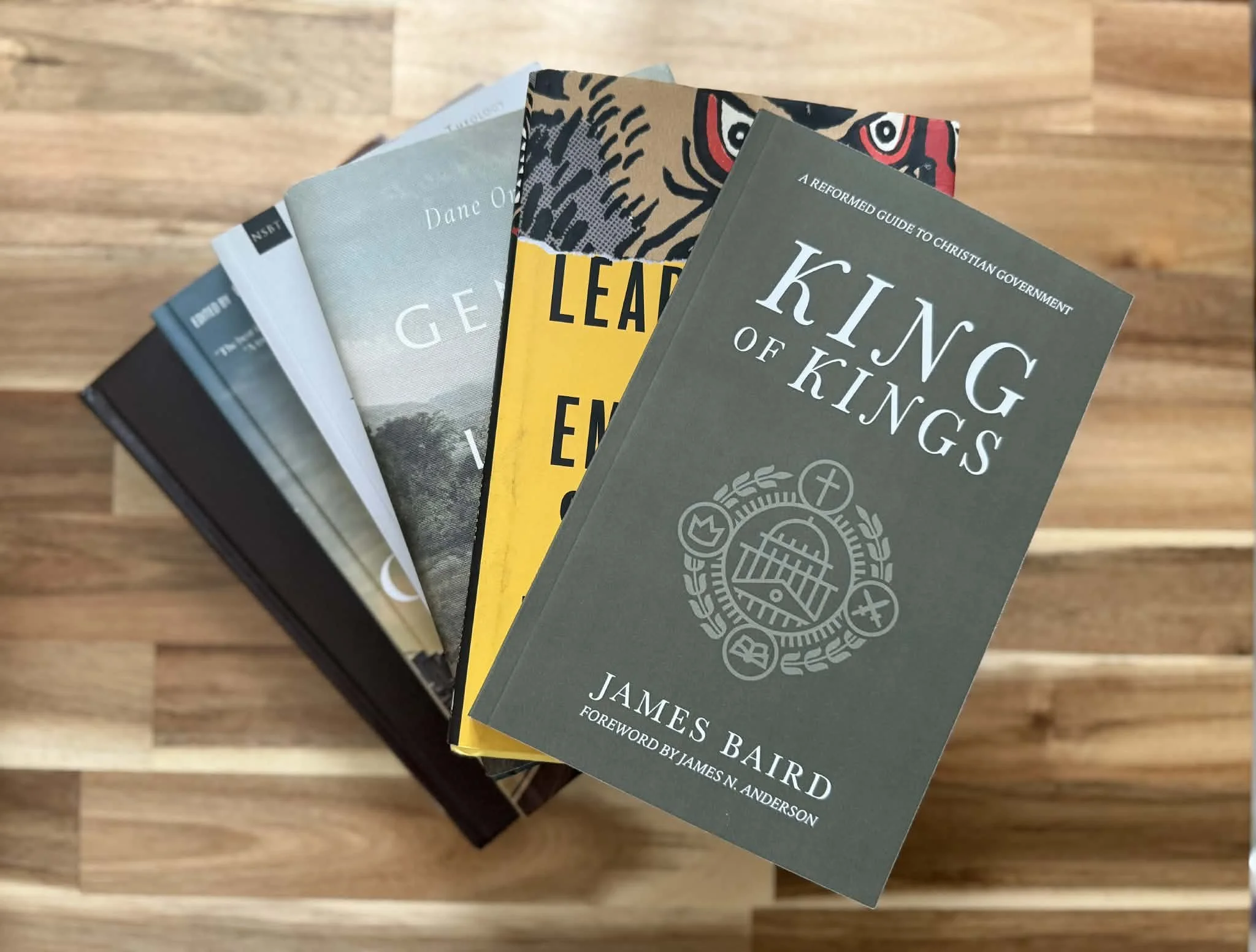
3. King of Kings: A Reformed Guide to Christian Government (James Baird). Baird’s book, which was published days after my book, covers the same general topic as mine does. I picked up the book expecting to find an ally, but I was left with more questions and concerns than I expected. In short, the foundation of Baird’s political theology is concerning as he possesses an overly naïve and positive view of the state. I believe such a foundation will eventually lead to a form of Christian statism. The weakness of this foundation is magnified because Baird fails to incorporate the Reformed view of human depravity. Lord willing, I will have more to say on this book in the near future.
There it is. While I read more books in 2025, these are the ones that stood out for better or for worse. Now, on to 2026.