The Strong Gods Never Left: A Review of Return of the Strong Gods by R. R. Reno
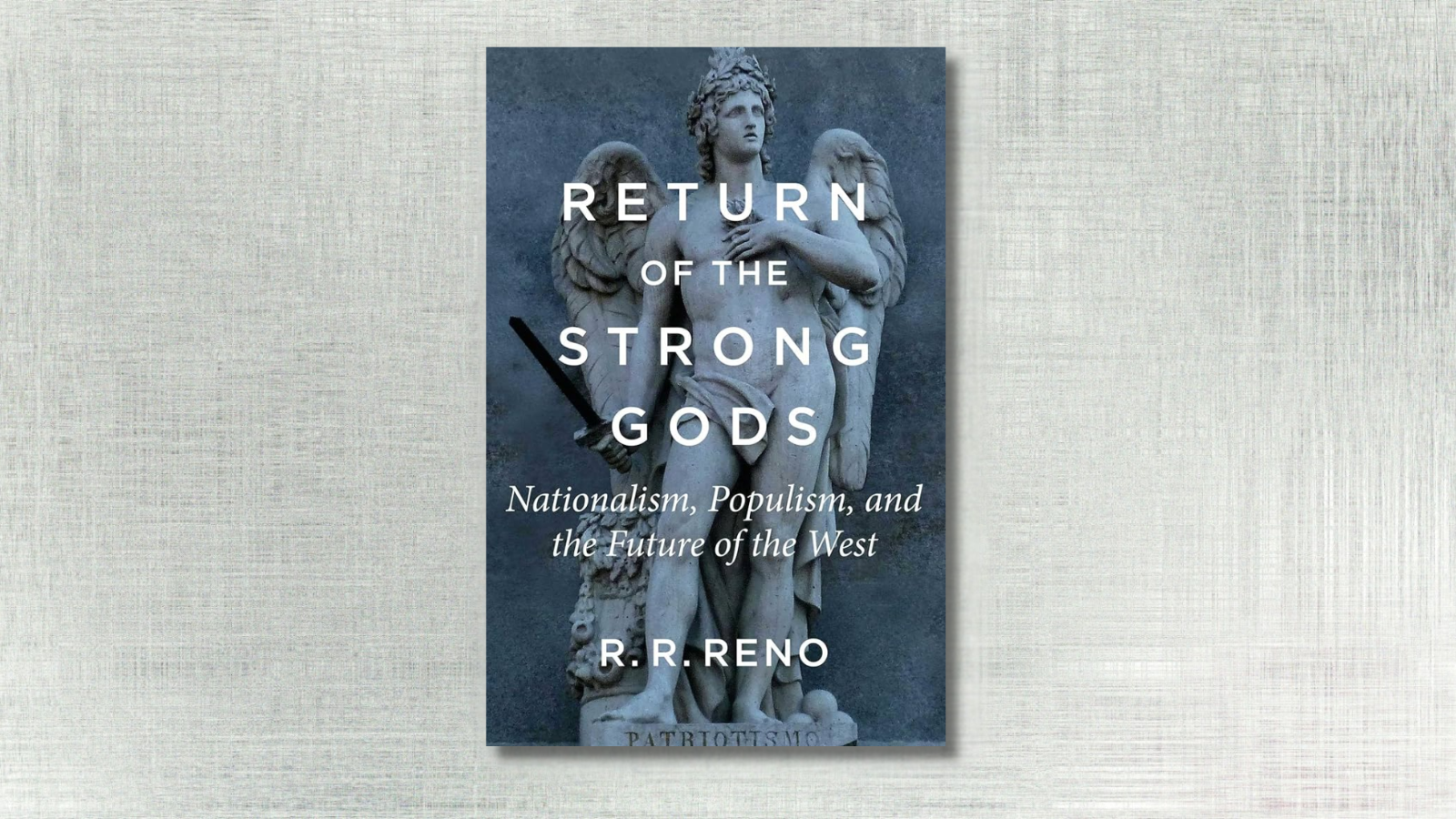
Recently, I finished reading R. R. Reno’sReturn of the Strong Gods: Nationalism, Populism, and the Future of the West.[1] I picked up the book seeking to understand the varied use of the term “postwar consensus,” a term that pervades much of Reformed political debate. In this book, Reno explains how the “postwar consensus” aided the West’s decline after World War II. He indicts liberals and conservatives for their obsession with an open society as an overcorrection to the horrors of fascism and Nazism.
Reno’s book is popular for a reason: His criticism of what many call “the uniparty,” or the swamp, is scathing and often on target. He identifies many of the ills that are eating away at the heart of the West. Yet Reno’s book often suffers from a lack of clarity, which is reflected in the various ways his followers use the term “postwar consensus.” Despite the book’s strengths, I believe Reno’s overall framing of the postwar consensus is lacking. He warns us of the return of the so-called “strong gods,” but as many other cultural critics have noted, these gods never left.
There is much to praise and critique in this book. Below are three strengths and weaknesses of Reno’s work.
Three Strengths of Reno’s Book
The strength of Reno’s work is found in his explanation of the West’s overcorrection to Nazism and fascism. Despite what some have suggested, Reno has no sympathy for Nazism. Humanity tends to see a problem and then swing the pendulum in the opposite direction to remedy the current problem. Yet, conservatives believe in the law of “unintended consequences.” In other words, we know that every solution we develop has a cost. It has trade-offs. Reno appears ignorant of this fact.
Public enemy number one for Reno is the “open society” that he claims is propped up by both the political right and the political left. I have issues with his framing, yet he rightly identifies these three problems.
First, Reno demonstrates how the political left advances an “open society” through multiculturalism and open borders. The postwar consensus, in overcorrecting for the evils of Nazism, demanded open borders, globalism, and an affirmation that every culture is “good” (except closed ones). Reno is correct in castigating the political left for its bludgeoning of anyone who loves his culture and seeks to preserve it. While all humans are created equal, cultural products are not. We can judge cultures according to the moral law of God.
Second, closely tied to this is how the postwar consensus has gutted life of truth, transcendence, and meaning. Reno dives deeply into how postmodern relativism has distorted and destroyed Western culture. If there is no ultimate truth, then multiculturalism follows. Reno sublimely notes, “A man who cannot affirm the border between male and female will find it difficult to defend a border between nations. Those who shrink from the strong god of truth are sure to see danger rather than blessing in the strong god of patriotism” (158). Reno argues that a weak view of truth leads to the weak gods of an open society. Reno is correct that a society must believe in some universal truth to survive.
Third, Reno rightly identifies the problems of globalism. For too long, many of our elected officials have prioritized other nations over those they were elected to serve. In pursuit of an “open society,” politicians have betrayed their own people. This is displayed in many ways, but one that Reno rightly identifies is global trade. While we must trade with other nations, such trade must not be detrimental to a nation or its ability to be self-sustaining. In short, globalization has cost many Americans their livelihoods and has made our nation vulnerable as we became dependent on less-than-friendly parties. In short, America should prioritize a level of self-sufficiency and independence for the good of its people and to protect its future. Here, I agree with Reno.
Three Weaknesses of Reno's Book
Despite its strengths, I cannot recommend the book because of its devastating weaknesses. There are many books that better address the concerns and timeframe that Reno does, and they do so without the same baggage. Below are three weaknesses that strike at the very heart of Reno’s thesis.
First, contrary to Reno’s thesis, the strong gods never left. They cannot return because they have always been present, even in leftist postmodernism. In his updated preface, Reno writes about how things have changed since Trump’s first term and the first publication of his book:
What I did not see while writing this book is that the American left, which opposed Trump bitterly, would pivot to affirm the return of its own strong gods. (xii)
This statement reveals a breathtaking ignorance about the very thought structures Reno critiques. The rise of Trump brought more clarity to the hypocrisy of the left, but their obsession with their strong gods has always been present. Postmodernism preaches about relativism, inclusivity, and tolerance**, but** the left has always believed itself to be the ultimate, unifying truth. Postmodernism has always had a totalitarian bent to it.
Cultural critics who have engaged postmodernism have noted this for decades, well before the rise of Trump. Reno appears utterly ignorant of this fact. Reno warns that now “the strong gods are returning” because the left is demanding adherence to its principles. Yet, the left’s hypocritical treatment of truth, tolerance, and openness has been the primary critique of postmodernism, critical theory, and social justice for years. Postmodernism, and its many deformed offspring, have always demanded total loyalty due to the fact that it is a totalizing worldview. For postmoderns, truth is relative, except for their own.
The entire premise of Reno’s book is that the West has succumbed to the “weak gods” of an open society, built on postmodernism. However, Reno now admits that the very people who prop up these weak gods are treating them as strong gods. This is not a new development for this movement. Postmodernism, multiculturalism, and wokeness have always been totalitarian ideologies. Those fighting in the trenches of culture, higher education, and denominational life have seen this firsthand for over twenty years. Thus, the entire thesis of Reno’s book falls apart because what he calls “weak gods” have always been “strong gods.” Postmodernism, multiculturalism, globalism, and open societies have always been strong gods. There will always be some ultimate ideal or unifying truth that man appeals to because this is how God made the world. To suggest that it is only now that the strong gods may “return” is to entirely misunderstand the last century or so of Western thought.
Second, Reno’s critique of conservatism misses the mark. According to him, the right’s main problem is that it embraced the postwar consensus and the open society through the avenue of the free market. Reno’s communist-lite distaste for the free market is hinted at throughout the book. He writes:
Over time, the tactic became a strategy, and in American conservatism the open society and free economy overwhelmed whatever was solid and permanent. (31)
Capitalism and technology disrupt traditional forms of community, often leaving individuals isolated. (107)
While global economic liberalization has dramatically increased wealth overall. The new wealth has been allocated unevenly, especially in the West. This inequality has strained the social contract to the point of breaking. (109)
If you think Reno sounds eerily similar to a Marxist professor, then you’re not alone.
According to Reno, the left saw freedom as freedom from borders and morality, but the right saw it as the free market. Allegedly, both of these pushed us to the horrors of the open society. Honestly, this critique stretches all credulity. How one can look at the behemoth of modern government’s interference in the market and think, “We have too much economic freedom,” is beyond me.
It is true that many on the right have supported the “open society,” but not through an adherence to the free market. The real problem for many on the political right is not that they embraced the free market too much but that they abandoned it. The problem is that many conservatives are every bit as big-government and as liberal on immigration, spending, and morality as the liberals are. Reno is correct that America has sold out its own citizens for global trade, but this was not driven by the free market. Why has manufacturing fled our shores? Because the government has regulated it into oblivion, making the American market too expensive. For Reno to posit that the problem with conservatives is that we’ve been too supportive of small government is laughable.
Finally, Reno is blind to how his post-liberalism commits the same mistake he warns against in the postwar consensus. Just as the purveyors of the postwar consensus overcorrected for the evils of fascism, Reno and other post-liberals are primed to overcorrect for the real evils of the postmodern perversions of our day. Reno rightly identifies many (not all) of our current problems, but his proposed solutions undermine classic liberalism with little thought to what would be lost. He appears unconcerned with what his tirades against freedom, small government, and capitalism could unleash. He is blind to the trade-offs his solutions would invariably bring—namely, a totalitarian government and economic squalor. The government cannot save us, even if it rejects the postwar consensus. We do not need more government but less. As John Adams noted, this can only work if we have a “moral and religious” people. A small government without virtuous people is impossible. The solution, in other words, is not found in the state but in a religious revival among the people, which would then be reflected in their elected representatives.
Conclusion
Of course, one could read this critique and dismiss it as a defense of the postwar consensus. This would miss my point entirely. I’ve fought multiculturalism, at great personal cost, for over twenty years in a variety of settings. I am against open borders, globalism, and postmodernism, and I have been called every name under the sun by angry leftists. Reno rightly identifies much of what ails our society, but his framework is severely lacking.
We do not need to cast out classic liberalism for post-liberalism or exchange the free market for government interference. What is needed is reformation, a return to our founding ideals. The problem today is not that classic liberalism has failed but that we have distorted and abandoned it. What is needed is a strong, narrow government that does its job by serving its people instead of foreign interests. We need a leaner government that unleashes the economic power of the people, not a state that tries to rule every facet of life. Contrary to Reno’s thesis, there will always be strong gods in every society. We need to choose the right God to serve. In the place of postmodernism, the people must turn to the living God; or, as Francis Schaeffer put it, to the God who is there. Such a return cannot be orchestrated by the government but must come through the declaration of the gospel. Only as people bend the knee to the Almighty Lord of Heaven and Earth can we escape the absurdities of the postwar consensus and the siren call of post-liberalism.
[1] R. R. Reno, Return of the Strong Gods: Nationalism, Populism, and the Future of the West (Regnery Gateway, 2019).